Monday, November 15, 2010

Okay, beer companies, enough is enough . . .

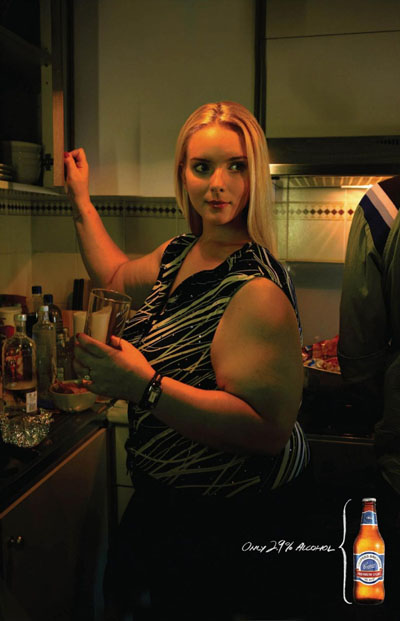
I must begin by saying that this is one of the most horrific ads I've seen in my entire life, and I spend a great deal of time searching for sexist and otherwise degrading ads to show at my women's rights club Real Beauty Revolution. The purpose of this ad, made clear by the (tiny) bottle in the lower right-hand corner, is to sell Coopers Beer. It doesn't take a rocket scientist to know that beer will always sell, regardless of whether or not it's heavily advertised, so this ad causes one to wonder how the Coopers Beer company can get away with printing something so blatantly disrespectful towards women. Most notably: overweight women.

If you haven't quite grasped the ad's concept (as it took me a minute to understand the first time I laid eyes on it), the miniscule caption in the lower corner reads: "Only 29% alcohol." In the bulk of the ad we see a woman, but not really; she's more of a hybrid, a ridiculous photo-shopped illusion of a woman. Her head is that of a young blonde (no doubt the representation of "beauty" here) and the rest is the body of a larger woman. Get it? 29% alcohol, 29% "hot chick"? This can also be read as: "when the women in your life aren't attractive enough, just take a swig of Coopers Beer and you'll be seeing [insert Hollywood actress here] in no time!


Another ridiculous ad for
Coopers Beer. The message
here?"Some women are so
unattractive, only balloon-ish
breasts would save them."
*Puke*
This ad is clearly aimed at men, as I don't know what woman could stand looking at it for more than five seconds without puking. Whoever created this ad obviously has no regard for the plight many women go through about their bodies, and is exploiting a barbaric stereotype that bigger women are "ugly" to get a cheap laugh. I hope you don't think biases are clouding my judgment when I say whoever created this ad is immature, malicious, and downright cruel.

Ads that aim to sell a product are usually predictable: their main message (argument) is to sell their product, and everything else is subtle, subliminal, or an afterthought. This ad, however, seems to be flip-flopped in that it's prominent, in-your-face message is "fat women are unattractive." Only after the audience gathers that fact do they realize the ad is for beer (the product is shoved into a lowly corner, after all). This is in incredibly bad taste, and just one of countless reminders that women are stigmatized each and every day for the way they look. It's bad enough that women are subjected to constant criticism from diet pill companies and late-night ads for exercise equipment like the Ab Circle Pro ("Not only will your Ab Circle Pro help you Lose Your Love Handles, it will help you workout and slim down your buns, hips, and thighs, too!"), but when this same sense of body-shaming is carried over to unrelated products like beer - it makes me wonder when people will finally step up and say enough is enough.


 If you'd like to unleash your rage on the Coopers Beer company, you can find their contact information here.

Saturday, November 13, 2010

Interview With Selena Torrado, Leader of a High School Feminist Club

A few weeks ago I met Selena Torrado, a teen living in New York who started her own high school feminist club called Femtastic! I was ecstatic to see that someone shared my passion for reaching out to teens about the "important" stuff; the point of this post is to say to you, Teenage Girls of the World, if your school doesn't already have a club that deals with women's rights, equality, feminism, etc. - IT NEEDS ONE. And if you think starting a club is too hard, Selena and I will attest that it's totally doable, and totally worth it. Check out my interview with Selena about her club Femtastic!, and see if it doesn't inspire you to start a feminist club of your own!

Danielle: What's your club called, and when/why did you decide to start it?

Selena: My club is called Femtastic. I decided to start it after becoming interested in feminism and exploring it on my own for a couple years. When I started high school I started reading books such as Full Frontal Feminism by Jessica Valenti, Female Chauvinist Pigs by Ariel Levy, and Intercourse by Andrea Dworkin. The ideas that these authors presented about gender identity and societal influence made extremely clear sense to me, especially after all of the confusion and mixed messages about gender roles in middle school. Reading these books was really empowering, in that they provided me with a context to view my evolving sexuality and status as a woman. As I found out about feminist blogs and forums such as Feministing and Bitch Magazine, it dawned on me that there is a whole feminist community out there that I really wanted to be involved in. The most accessible way for me to become involved was to create a feminist community in my school, where I spend the most time anyway. I started talking to my friend Zoloo, who is also interested in feminism and gender issues, and the club grew from there.

D: What has your club accomplished so far, and what do you have planned for the future?

S: So far, my club has started our Portrayal of Men and Women in the Media unit. We have discussed messages about gender roles that music videos, tv shows, and advertisements portray. We identified the impact these messages have on our personal lives, and reached the conclusion that the youth needs to be more directly involved in media development, so that the diversity of our thoughts, feelings and experiences are accurately portrayed. We are working on figuring out a concrete way that youth involvement can be implemented by entertainment firms such as MTV, VH1 and Disney Channel.

For the future, we plan to cover many more topics such as, but not limited to, Global Feminism, Teen Sexuality, Reproductive Rights, Prevalence of Pornography in Teen Culture, and the Importance of Comprehensive Sex Education. Our next unit will probably be Global Feminism. Our primary activity during this unit will be to team up with the Girl Up Campaign, a UN organization that works to mobilize American teens to raise money for programs that help combat issues such as Child Prostitution, Early Marraige, and Lack of Education, all of which are issues that girls in developing nations face. We plan to put on a fair which would inform people about the campaign and the issues it tackles. We hope to bring in Cornell professors to speak about some of these issues. All proceeds from this event will go to the Girl Up campaign.

In addition to this, we also plan on developing some kind of middle school outreach. We have all agreed as a club that middle school is the time when many girls question and are bombarded with opinions about how they should act and what they should believe as women. We hope to talk to and support middle school aged girls and boys during this period of huge change and confusion.

D: What's the key to attracting (and maintaining) members?

S: I think that the key to attracting members is to advertise throughout your school. I created a bulletin board in a major hallway, passed out fliers, and made announcements on our school TV. Make sure that the student body is aware of the clubs existence. Also, it is important to be prepared to describe exactly what your club is about, what you hope to achieve, and what some of the activities will be, because there is a lot of confusion regarding the word “feminism” that you will need to clear up.

As for retaining members, that is something I am still learning, as my club is relatively new. I try to really involve the club members in discussions and make them feel like their opinion matters. Beyond that, I will learn as I go along.

D: What advice do you have for other high school students who'd like to start a feminism/women's rights club, but don't know where to start?

S: My advice to students who want to start a feminist club is to reach out to your community. I have gotten so much support from my local university (Cornell), Planned Parenthood, and school. I was actually shocked by how supportive, helpful, and excited most people were about the club. The majority of opportunities have come from groups and individuals in the community. For example, our local Planned Parenthood invited us to their yearly celebration, where we got to hear Michelle Goldberg, journalist and author of The Means Of Reproduction: Sex, Power and the Future of the World, speak. The Cornell Women’s Resource Center has been really helpful and offered us access to their speakers and events, as well as a way to apply for co-sponsorship for our own events. Basically, seek out people and organizations in your community who you think would support you, and don’t be afraid to ask for favors and advice.

D: Why do you think girls are sometimes reluctant to call themselves feminists? Is there anything we, as teens, can do about this?S: I think that girls are reluctant to call themselves feminists because there are so many negative connotations surrounding that word. I think that for most people the word “feminist” evokes an angry, man bashing, bitter female who complains about the “patriarchy” but does not have much to back up her complaints. One way to combat this is through education. This image of a feminist is an ignorant one, and the way to combat ignorance is with information. If you identify as a feminist and have knowledge of specific feminist beliefs, ideals, and progress, don’t be afraid to share it with others. Feminist theory and ideology applies to almost every moral, scientific, economic, global, and interpersonal topic there is, so there are plenty of chances to bring up feminist ideas both in class and in personal discussions.

Thursday, October 21, 2010

Finally, A Post About Gloria Steinem

Ask any feminist born during or after the tumultuous 60's and 70's who their hero is, and the answer will come back a resounding Gloria Steinem. 

Gloria Marie Steinem was born on March 25, 1934, and is widely regarded as the poster-child for the modern Women's Liberation Movement. As one of the many women inducted into the National Women's Hall of Fame - along with Abigail Adams, Betty Friedan, Ella Fitzgerald, and my personal favorite, Susan B. Anthony - Steinem is a renowned journalist and political activist who has devoted her life to bringing humanitarian issues into the public scope.

After my life-altering decision to call myself a feminist, it felt almost automatic that I should look up to Gloria Steinem, the woman whose name graces every reputable feminist book and blog at least ten or fifteen times. It wasn't until after I started researching her life and accomplishments, however, that I felt my admiration snow-balling; with every new triumph for feminists (and humanitarians in general), I thought yes, this is my idol.

Interestingly enough, Steinem did not come from a feminist family, or even one that was particularly conscious of women's rights or societal issues. How, then, did she go on to become an animal rights activist, civil rights ambassador, political commentator, and “the face of feminism"?

When Steinem was just a few years old, her mother had a debilitating nervous breakdown that hurled her into a world of delusions. The woman couldn't hold a job - let alone take care of herself for any length of time - so her husband ended up divorcing her. While Steinem has made it clear that she doesn't blame her father for leaving, years of being forced to care for her mother opened her eyes to many of the injustices women faced and still face, such as constrictive gender stereotypes and horrifically low wages.

Since her unintentional "aha" moment all those decades ago, Steinem has become an irrefutable force with a list of achievements ten miles long. She co-founded Ms. Magazine, the first magazine written exclusively by women, for women. She campaigned for the Equal Rights Amendment, and many other laws that would seek to destroy gender discrimination. She's appeared in every major magazine from Newsweek, to Time, to People, to Parade, and has been a major contributing factor in introducing the feminist agenda to a larger audience. She was arrested in 1984 for protesting apartheid in South Africa (which, like our nation’s own bought of racial segregation in the early-to-mid 1900's, is the forced separation of people based on ancestry), and has worked closely with countless organizations such as the Women's Media Center, Equality Now, Choice USA, the National Women's Political Caucus, the Planned Parenthood Action Fund, and First Peoples Worldwide.

When did she find time to breathe, I wonder?

To think that one woman - no, one person - accomplished all this is just mind-boggling. For a split second it makes me think "and what have YOU accomplished, Danielle?" but then I realize I still have another seventy or eighty years (keep your fingers crossed!) to follow in Steinem's footsteps. She is such an inspiration: it's one thing to be a loud, proud feminist nowadays when there are hundreds of thousands of women to back you up, but it was something entirely different to be a progressive (some would say "radical") feminist in an era when the woman's place was undisputedly in the home. I admire Steinem for her courage to stand up when few others did, for her ambition to take on the world without letting sexist stereotypes or expectations deter her, and for the fact that, even now, she doesn't give a flying fig about what people think of her.


When one thinks of our nation’s earliest pioneers of women's rights, they may think of the iconic Sister Suffragette made famous in the 1964 film Mary Poppins: prim, proper, middle-aged, white. While the suffragettes of the late 1800’s and early 1900’s did do unbelievable things for our country, Steinem took women's liberation a step further by grabbing feminist stereotypes by the horns. She chose to study politics in lieu of marriage and raising a family, showing that women are capable of making it on their own. She was one of the first people to tackle traditionally taboo subjects such as domestic violence, abortion, and genital mutilation, and gained a cult following for her insightful journalist pieces on said topics. She even used humor to deny (and perhaps stun) those who believed feminists are all stuffy, hairy hags who sit around drinking tea and thinking up what to complain about next. “Gloria Steinem” and “Women’s Liberation” are almost synonymous; Steinem is a pioneer, role model, and modern-day Superwoman.

If I’ve learned anything from Gloria Steinem, it’s simply to accept yourself for who you are. I mean, after claiming the feminist label a million thoughts ran through my mind: what will people think of me? What will my friends say, or my parents? Will people look at me differently in the future? Will they understand? It was almost as if my entire success as a feminist was dependent on how others viewed me. Isn’t that messed up? But after reading about Steinem and her amazing history, I knew she never cared about what people thought about her. Whether they worshipped her, mocked her, exalted her, or despised her, it had absolutely nothing to do with who she was as a person. So, in a way, Gloria Steinem has helped me to accept myself for who I am, and simply be.


Works Cited

"Gloria Steinem Biography." Biography.com. A&E Television Networks. Web. 29 Sept. 2010.

"GLORIA STEINEM." Feminist.com. Feminist.com. Web. 28 Sept. 2010.

"Gloria Steinem." The Women's Conference - Empowerment, Inspiration and Education for Women - The Home for Architects of Change. Web. 29 Sept. 2010.

"The Official Website of Author and Activist Gloria Steinem - Groups." The Official Website of Author and Activist Gloria Steinem. Gloria Steinem. Web. 29 Sept. 2010.

"Women of the Hall." National Women's Hall of Fame. Web. 29 Sept. 2010.

Friday, October 15, 2010

"Jewish? And feminist? Did I hear you right?"

No, I'm not Jewish. But a good friend of mine is, and when I posed the question "can feminism and religion truly coexist?" she was the first person to step up to the plate.

I consider myself a Unitarian Universalist, humanitarian, secular humanist - whatever you want to call it - so I know next to nothing about the inner mechanations of the major world religions. I wanted to write about feminism and Christianity, feminism and Islam, feminism and Buddhism (and so on), but it would be pretty hypocritical/stupid of me to try to write when I'm not "on the inside," if that makes sense.

Here to speak on behalf of Judaism is my good friend Talia, authoress of a blog cleverly titled Star of Davida. Talia describes herself as "A loudmouth, opinionated teenage Femidox (feminist Orthodox) Jew with a love of unadulterated Judaism, a fascination with her people's historical women, and way too much time on her hands," so you can bet her blog is worth checking out!

Here's what she said in response to my question:

"In June, someone asked me what my summer plans were. 'Well, I’m going to work on my Jewish feminist blog Star of Davida,' I replied. The person I was talking to looked confused. I could tell he was holding back from saying, 'Jewish? And feminist? Did I hear you right?'

It’s a reaction I’ve gotten from quite a few people; no one seems to be able to comprehend an Orthodox Jewwho’s also a feminist. I find it kind sad that Judaism, a religion that is so feminist, has been labeled as a patriarchal, sexist religion when it’s really not. The Torah, the central holy book of Judaism, continually affirms women’s equality.

When the Jews were given the Torah, God said to Moses, “So shall you say to the House of Jacob and the Children of Israel” (Exodus 19:3). The term “Children of Israel” is how the Bible refers to the Jewish nation, so commentators question the seemingly-extra “House of Jacob.” Most explain that “House of Jacob” refers to the women, while “Children of Israel” refers to the men. The commentators (who lived in medieval communities not famed for being pro-feminist) next question why it puts the women before the men.
At Creation, God created Adam and told him not to eat from the Tree of Knowledge. God then created Eve, but did not tell her to abstain from the Tree directly, leaving it to Adam to pass on the message. The snake was then able to convince Eve to eat from the Tree of Knowledge, Eve convinced Adam, and the two were expelled from the Garden of Eden.

Seeing how it didn’t work out so well when God didn’t command womankind, God made up for it and commanded the women first at the giving of the Torah. It worked this time: when Moses didn’t come down from Mount Sinai on the expected date and the Jews created the Golden Calf as his replacement, the women didn’t participate.

This is one example of many in Judaism that shows that neither men nor women should have supremacy. Having ovaries does not make someone less of a person, and Judaism is fully aware of the fact. God wants equality for all people, of any gender, race, or religion."
___________________________

Well, what's your opinion? Can feminism and religion truly coexist? Whether you're Christian, Jewish, Muslim, Buddhist, Hindu, athiest, agnostic, or a Unitarian like me, send me your answers! I'd love to hear from you and publish your thoughts in an upcoming post, along with your name, blog, and anything else you'd like to promote. Check out the submission rules here.

Wednesday, October 13, 2010

Pat Robertson's NOPE (Parody of Obama's HOPE)

Here's a little piece I whipped up for my AP Language and Composition class. We're studying parodies . . . but I was totally serious when I made this. *laughs* Pat Robertson is my nemesis, and I kid you not, that's exactly what I said during my presentation! My teacher really appreciated that.

Here are some lovely videos of Pat Robertson, well, just bein' himself!

Pat Robertson Being Himself
Pat Robertson . . ."Blessing in Disguise"
Falwell and Robertson . . . After 9/11


Make sure you watch the last one. Ol' Patty is talking with a guy who claims feminism is "an alternative lifestyle," and that we (and "the abortionists") caused God to punish us with the 9/11 attacks.

Thursday, October 7, 2010

I'm Back (Kind Of . . . )

Hey everybody! It's been a while since my last post, so I thought I owed you all an explanation. I've been back at school for about a month now, and boy, it doesn't get any easier, does it? My routine has basically been waking up 6:00, going to school, getting home at around 5:30, taking a nap, doing homework until the wee hours of the morning, crashing, and then starting the cycle all over again. In short, I haven't had much time to relax, let alone write.

Though I don't think I'll be cranking out epics anytime soon, I thought up a pretty ingenious plan. To make school a little more bearable, I've been bringing my passions (i.e. read the rest of this blog) into the classroom. A week or two ago we had to write an article as if we were a "muckraker" back in the late 1800's exposing a dire issue; I wrote about women's rights. In my Interpersonal Relationships class we had to do a presentation on "someone we admire"; I did mine on Gloria Steinem. Even today we were assigned to write a satirical piece on a current societal issue; my topic is abortion. I figure: when given a choice, I'll relate my schoolwork to the issues that I actually care about, and then I can just post 'em up on here! Genius, pure genius . . .

On an unrelated note, I'm extremely excited for Real Beauty Revolution this year. For those of you who don't know, I started at club called Real Beauty Revolution at my high school, and it's for anyone who's interested in gender equality, body image, media stereotypes, relationships, self-esteem . . . you know, the juicy stuff. Though I've been having a heckuva time getting the word out, I think the club has had a good start. We only had about ten people at our first meeting (half of which were my friends, so they don't really count!), but it was really intense. We did some of the activities from If You Really Knew Me and saw that, wow, we're all dealing with crap in our lives. We talked about how people at school never stop to get to know the real us - that we're always stuck in a reputation, an image - but we're so much more than that. The first meeting saw a lot of tears, but I think that's so important in getting people to realize RBR is a safe place to talk, and vent, and most importantly, encourage one another.

We had our second meeting yesterday and I am ecstatic to report that we had almost twenty people attend! Our discussion topic for the day was "true beauty," so we looked at ridiculous ads that try to tell us how we "should" look. Bigger breasts. Plastic surgery. Virtually no fat cells. It's exhausting to be a women sometimes when we're tirelessly bombarded with these messages, but we don't have to let them control us.
Next, we wrote our fears and insecurities on balloons and stomped on 'em . . . it was really fun and loud. I only hoped the administrators didn't come running into the breezeway thinking shots were being fired *smiles*

Anyway, that's my life right now. School, homework, Real Beauty Revolution. I'll try to write some original pieces in the near future when I actually get some free time, but for right now you'll have to settle for recycled History and English assignments!

Saturday, September 11, 2010

"Souls Speak Out" Against Domestic Violence

Sexual and domestic violence is all-too-real for many women across the United States (and the world), though most of us can't even fathom what must go through a woman's mind as she is being abused and left to deal with the lingering emotional trauma, or in some cases, (undeserved) guilt. If you've been affected by domestic violence and/or sexual abuse and would like to share your story, or read stories from other survivors, check out SoulSpeakOut:

"SoulSpeakOut is a space for survivors of all ages, genders, sexualities, cultural identities, nationalities, and abilities who have experienced sexual assault, domestic violence, incest, child sexual abuse, sexual harassment or any other violation of one’s body or sense of self to connect, validate and empower each other. Either anonymously or by name, survivors are encouraged to submit stories, testimonies, poetry or artwork concerning their experiences."

Women know that when we talk, we're not always looking for a solution. Sometimes we talk so we can heal, and so others will listen, and that's enough.

Tuesday, September 7, 2010

My Interview on "Feminists For Choice"

I recently had the pleasure of being interviewed on Feminists For Choice, a site that puts a spotlight on young activists to see what inspires them. Check out this excerpt:

"Feminist Conversations is a weekly column where we talk to feminists from around the country to find out what Feminism means to them, and what types of activism they’re up to in their neck of the woods. Today we’re talking to Danielle Burch, founder of a new blog called Experimentations of a Teenage Feminist. Danielle is a teenager, humanist, Unitarian, progressive rock lover, compulsive doodler, worry-wart, and rice cake junkie. Here’s what Danielle said when I caught up with her.

When did you start your blog, and what was your inspiration?

I started Experimentations of a Teenage Feminist back in June. School had just ended, giving me plenty of time to tackle the 10-foot-high stack of feminist books I’d checked out from the library (but had been too busy to read), and I honestly felt like I was on top of the world. I like to call this my “aha!” period. I felt so good about my new discovery – a philosophy that encompassed the beliefs I’ve had since childhood – that I was bursting with an energy that desperately needed an outlet. My blog allows me to vent, rant, muse, gush, and decompress, and it was literally my “coming out” as a writer and feminist. In one fell swoop I went from a girl who cringed at the thought of letting people read her English papers (let alone her personal thoughts), to someone who was shouting “Hello World!” from the rooftops. It was absolutely liberating.

When did you first call yourself a feminist, and what influenced that decision?


Though I’ve always been a stickler for women’s rights (human rights, actually), it took me years to discover feminism. But now that I have, I’m turning into the strong, compassionate, courageous person I’ve always aspired to be – and I’m loving every minute of it!


I’m the typical “I’ve-always-been-a-feminist-I-just-didn’t-know-it” case. As far back as I can remember, I’ve been disgusted by discrimination – racism, classism, homophobia – but sexism hits especially close to home. Once I started becoming aware of the stigmas and stereotypes women face on a daily basis – most notably sexist crap in the media – I was shocked and appalled, but didn’t know what to do about it. About four months ago I started researching activist groups online, and I’m so glad that I did. It only took about two seconds after reading the definitions for “feminist” that popped up on Google to decide my place in life . . ."


(Continued)


Check out the full-length article to find out what feminism means to me, why I don't think more teenagers are calling themselves the "f-word," and which famous feminist I'd meet if I had the chance!

Monday, September 6, 2010

I'd Like To "Juice" Jose Canseco's Head

Hey everybody, I'd just like to make a disclaimer that because I'm back in school, I won't be able to post as frequently as I'd like to. (But don't blame me, blame the two hours of Calculus homework we're getting each night!) Anyway, here's my response to another article by Maureen Dowd called Where's the Road Beef?:

In this article by Maureen Dowd, we’re given a glimpse into the world of major league baseball via Jose Canseco’s Juiced, where behind the glitz, glam, and bobble-heads, America’s boys of summer are using terms like slump buster and road beef to describe women. What is a slump buster, you ask? “It could mean [a woman who is] big, or ugly, or a combination of both,” says Canseco, and it’s how some of our beloved hard-hitters are coping with a bad season. As former Chicago Cubs first baseman Mark Grace put it, they’ll find “the fattest, gnarliest chick” possible and (to put it lightly) use them.

I use toilet paper. I didn’t know it was acceptable to use human beings.

Dowd’s article isn’t exclusively about Canseco and friends; in the grand scheme of things it’s about archaic standards of beauty, and the stigmas overweight women face each and every day. As she points out, “TV is full of ‘Beauty and the Beast’ pairings, with fat, lazy husbands and foxy, impressive wives.” But do we ever acknowledge relationships between slender guys and larger women? No. We live in a society where women are judged by their looks and men for the size of their wallets, and heaven forbid we reveal the face of “real” women who don’t have money to shell out for liposuction, implants, or Botox - and who wouldn’t want those things, anyway.

This article hits home because I can relate to it. I’m sure a lot of women and young girls can relate to it. Feeling like an outcast, feeling like your worth is determined by your body . . . it’s an unfortunate, unavoidable reality. And even if Dowd doesn’t call us to do anything to change the mentalities of locker rooms everywhere, her last line deserves an Emmy: “One thing is for sure, though. Guys who look at fat women as ‘slump busters’ are fatheads.”
Related Posts Plugin for WordPress, Blogger...